In 2021, we started our Top 10 Deals series to answer a question we kept hearing from VCs and LPs: does women's health actually produce exits? Five years and 50 deals later, the answer is clear. It does, and at a scale few predicted.
Each year we pick ten transactions that tell us where the market is going: strategic acquisitions, IPOs, private equity buyouts and growth rounds across fertility, maternal health, menopause, oncology, sexual health and more. Before we kick off the 2026 series, we're looking back at what five years of deals have taught us.
Five years, five chapters
Disclosed deal value on our lists went from $4.6B in 2021 to $32.6B in 2025, a 7x increase, after bottoming out at $1.9B in 2023. Here is how each year read at the time.
2025: The IPO window reopened and megadeals arrived
TPG and Blackstone take Hologic private ($18.3B); BillionToOne IPO ($4.4B); Hinge Health IPO ($2.5B); KKR buys Karo Healthcare ($3B); Eli Lilly buys a breast cancer therapeutic ($2.5B); Oura raises $900M at an $11B valuation.
2024: Unicorns and serial acquirers
Boston Scientific buys Axonics ($3.7B); Genmab buys ProfoundBio ($1.8B); Insud Pharma buys Viatris's women's health business ($1.2B); Hologic buys a fibroid treatment company ($350M) and Endomag ($310M); Flo Health and BillionToOne reach unicorn status.
2023: Deals kept closing in the worst M&A market in a decade, but sizes shrank
L Catterton buys Thorne ($680M); Pharmavite buys menopause brand Bonafide ($425M); CooperCompanies buys Cook Medical's OBGYN line; Gilead buys breast cancer biotech XinThera and Cosette buys menopause drug Intrarosa (both undisclosed).
2022: IPOs and SPACs stalled, so M&A carried the year
Carlyle and PAI buy Theramex ($1.4B); Cooper buys Cook Medical's reproductive health portfolio ($875M); Essity buys Knix ($320M); Kimberly-Clark takes majority stake in Thinx ($181M); Ro buys Dadi ($100M); our portfolio company Gennev acquired by Unified Women's Healthcare.
2021: A hot market: SPACs, mergers and medtech
Cooper buys Generate Life Sciences ($1.6B); Lovehoney and WOW Tech merge ($1.2B); Owlet goes public via SPAC (~$1B); Organon buys Alydia Health ($240M); Hologic buys Biotheranostics (~$230M).
Who's buying
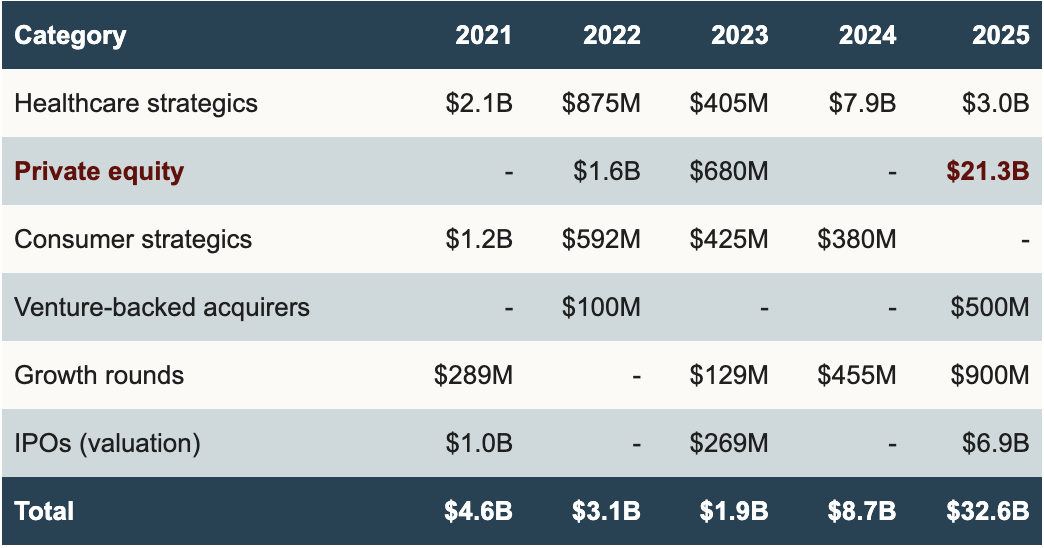
This is not every deal in women's health. It covers only the 50 deals featured in our Top 10 Deals series from 2021 to 2025, grouped by buyer or exit type, with disclosed values added up.
What we learned
1. Exits are getting bigger. Exit value on our lists grew from $4.3B in 2021 to $31.7B in 2025, more than 7x. Billion-dollar exits went from zero in 2023 to five in 2025. And even in 2023, when overall M&A hit its lowest level since 2013, women's health deals kept closing.
2. Private equity went from dabbling to dominating. In 2022, PE deals on our list totaled about $1.6B. In 2025, they hit $21.3B, more than every other category combined, led by TPG and Blackstone's $18.3B take-private of Hologic and KKR's $3B purchase of Karo Healthcare. Hologic went from serial acquirer on our 2024 list to the largest target we have ever covered.
3. Healthcare strategics are the steady buyers. Pharma, medtech, provider and diagnostics companies showed up every single year, from Cooper's $1.6B Generate deal in 2021 to Hologic's two acquisitions in 2024 and Eli Lilly's $2.5B deal in 2025. They buy rather than build, and in 2024 alone they accounted for $7.9B.
4. Consumer and venture-backed buyers fill out the middle. Consumer strategics like Reckitt, Essity, Kimberly-Clark and Pharmavite remain a reliable exit for consumer brands. Their deals on our lists have stayed under $600M a year. Venture-backed companies are buyers too: Ro, Nurx and Kindbody all acquired in 2022, and in 2025 Remedy Meds bought Thirty Madison, itself an acquirer on our 2022 list.
5. Exit paths widened. In 2021, companies like Owlet reached public markets through SPACs. That window shut in 2022. It reopened in 2025 with real IPOs from BillionToOne and Hinge Health. Generalist growth investors arrived too: General Atlantic led Flo's round and Fidelity led Oura's.
6. The arbitrage is still here. Only 0.5% of venture funding goes to women's and sexual health, while there is a huge active acquirer universe. Founders raise early stage VC funding at a discount and sell their companies at a premium. That gap is why we invest at Seed and Series A.
What's next
Over the coming weeks, we'll break down the ten deals that defined 2026. We have already seen more than $23B in transaction value this year, and we expect more to be announced in the coming two months. A few early signals: Organon, a buyer on our very first list in 2021, agreed to be acquired by Sun Pharma at an $11.75B enterprise value. Apollo invested €3B (about $3.4B) for a minority stake in Bayer's contraceptives business. Ferring agreed to buy fertility startup Gameto for up to $1.4B.
If five years have taught us anything, it's that the companies building in women's health today are the acquisition targets of tomorrow. Follow along as we kick off year six.